Glossary of Fence Technical Terms: A Guide to Reading Quotes and Product Pages Correctly
For someone having a fence built for the first time, fence quotes and product pages are sometimes full of technical terms that are hard to understand. When expressions such as “50 x 50 mesh size”, “1.4 – 1.6 mm box profile”, “hot-dip galvanizing”, “half-flange post” or “gear rack” are not understood correctly, comparing quotes becomes difficult. This glossary of fence technical terms was prepared to explain the most common concepts in plain language. We have grouped the terms by topic and, next to each term, noted why it matters when making a decision.
Measurement and Dimension Terms
Wire thickness (wire diameter)
Wire thickness refers to the diameter of the wire used in products such as panel fence, chain-link and barbed wire, and is usually given in millimetres. As wire thickness increases, the strength of the wire generally increases. For coated wires, it is helpful to ask whether the stated measurement includes the coating or refers to the bare wire. For example, in our barbed wire products, the wire diameter and the barb wire diameter are stated separately.
Mesh size
Mesh size is the size of the openings formed by the wires in chain-link and panel fences. The expression “50 x 50” indicates that the openings are approximately 50 mm by 50 mm. The smaller the mesh size, the smaller the objects and animals that can pass through the fence; it can also make it harder to find footholds for climbing. Our galvanized chain-link system is offered with a 50 x 50 mesh size.
Panel height and width
In panel fences, each panel is produced in specific heights and widths. Panel width directly determines post spacing.
Roll length
For products supplied in rolls, such as chain-link and barbed wire, this is the length of material in one roll. Our galvanized and PVC-coated chain-link products are offered in 10, 15, 20 and 25 metre rolls.
H value
In plastic wrought-iron style models, the “H” value next to the model name indicates the height option. For example, Semazen H100 or Lalehan H35.
Profile and Structure Terms
Box profile
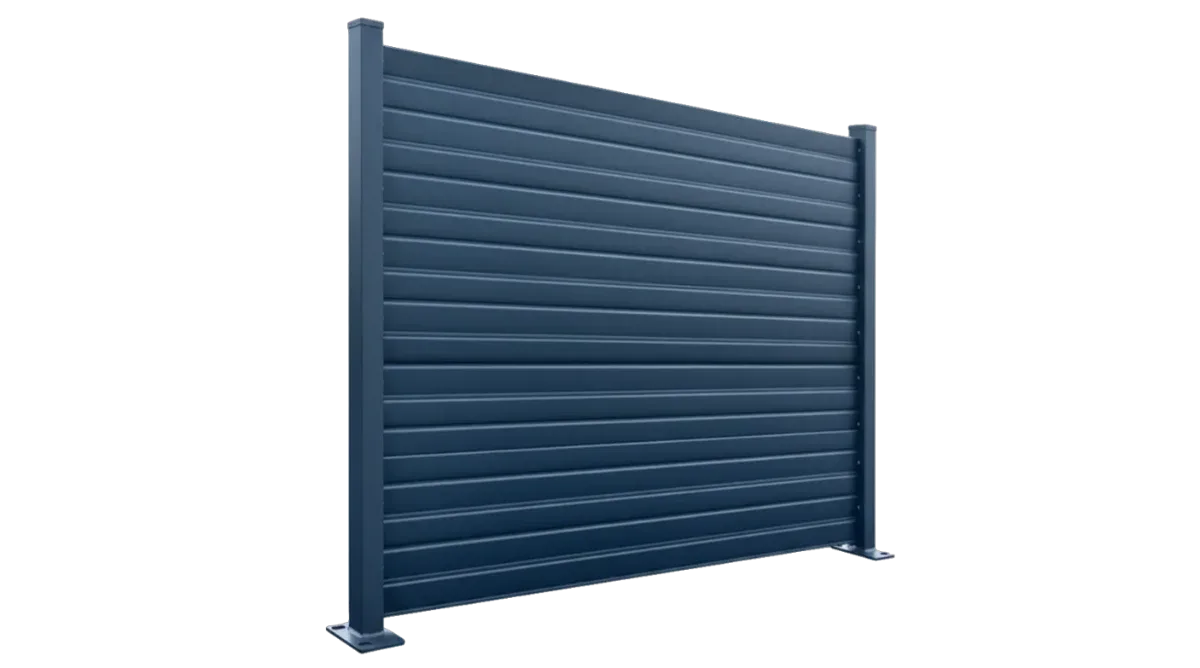
A box profile is a hollow metal profile with a square or rectangular cross-section. It is often used in the posts and frames of louvre fences and in gate frames. The profile size (for example 40 x 40 mm) and the wall thickness (for example 1.4 – 1.6 mm) are stated together. Our louvre fence model uses 1.4 – 1.6 mm box profile.
Wall thickness
In hollow profiles such as box profiles or tubes, this is the thickness of the metal wall. Of two profiles with the same outer dimensions, the one with the greater wall thickness is generally more durable. Check whether wall thickness is stated next to the profile size in quotes.
Slat
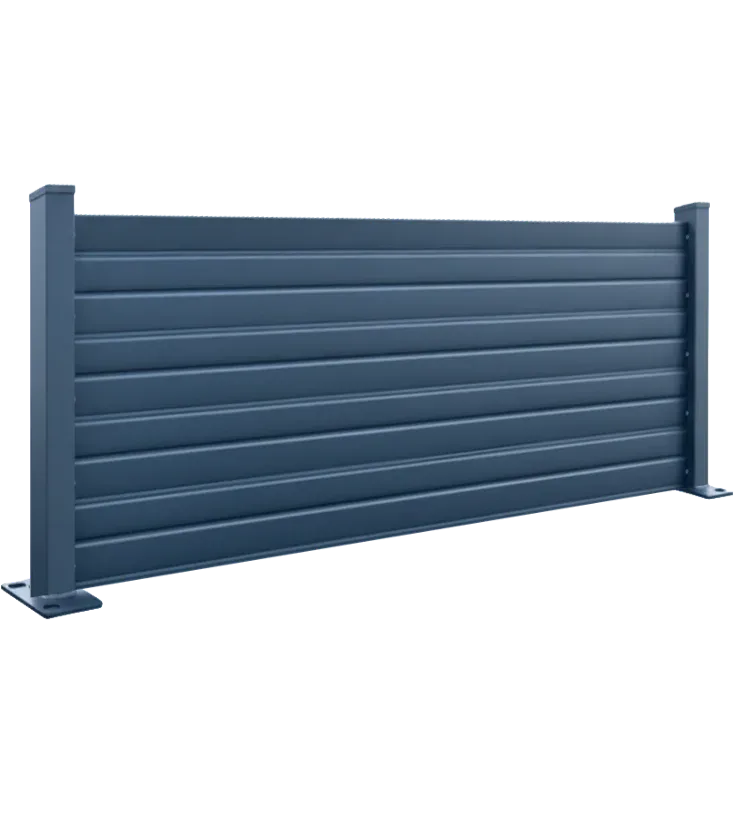
Slats are the strip-shaped pieces arranged horizontally in louvre fences to block the view. Slat thickness and form affect the appearance of the fence and how it interacts with wind.
Air gap (louvre vent)
Air gaps are the openings left between louvre fence slats that let air pass through. By letting part of the wind pass, they balance the load compared with a fully closed surface. In standard installation the air gaps are at the bottom and are not visible when viewed from the front.
Double panel and single panel
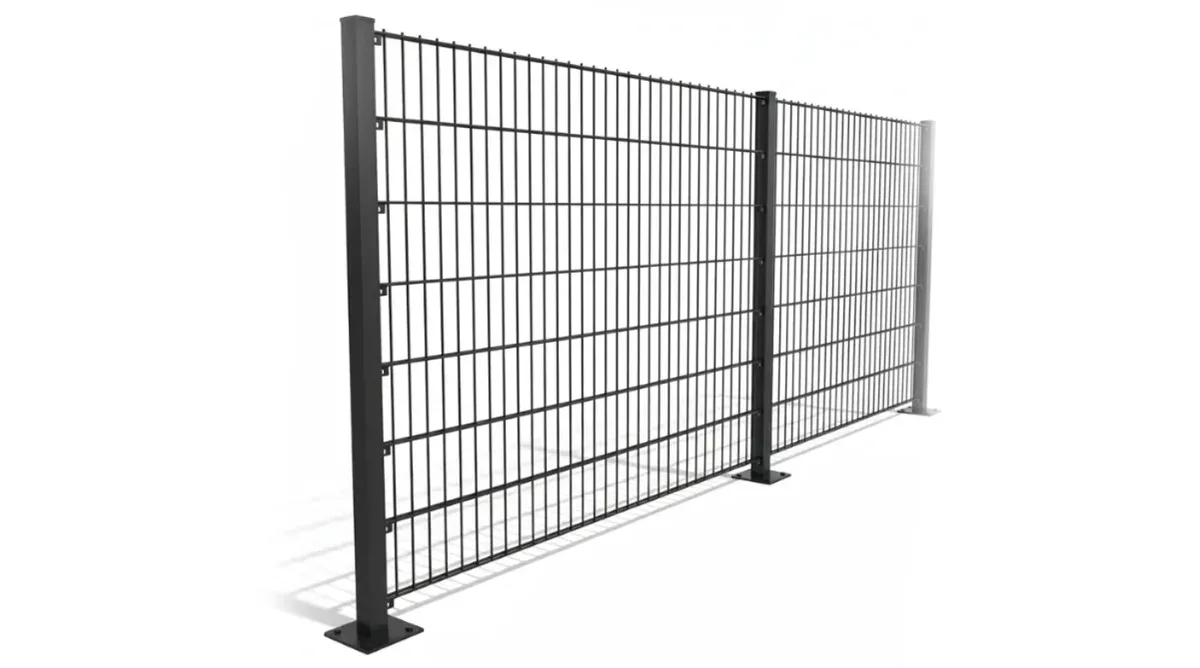
Double panel fence is a more rigid type of panel in which the horizontal wires are used in pairs and the vertical wires are welded between these pairs. Single panel fence has single horizontal wires and a lighter structure.
Coating Terms
Hot-dip galvanizing
This is coating a steel part by dipping it into a bath of molten zinc. A relatively thick zinc layer forms that is metallurgically bonded to the steel. The zinc corrodes before the steel and so protects it.
Electro-galvanizing
This is applying zinc to the steel surface by an electrolytic method. A thinner, smoother layer forms; it is generally used as a primer layer under paint.
Electrostatic powder coating
This is spraying powder paint onto the metal surface with the help of an electric charge and baking it in an oven so that it fuses with the surface. It gives a smooth, hard and decorative layer.
PVC coating
This is applying a plastic layer over galvanized wire. It provides extra barrier protection and a coloured appearance. PVC-coated chain-link wire is produced by this method.
RAL code
A colour coding system that allows colours to be defined in a standard way. For example, anthracite grey is commonly referred to in the sector by the code RAL 7016. The same RAL code can be perceived differently depending on gloss level and lighting conditions.
Touch-up
This is covering scratches or damaged areas in the coating with suitable paint. It is also applied to cuts and holes after installation.
For a comparison of coating types, see our article on the difference between galvanizing and electrostatic powder coating.
Installation and Connection Terms
Flange
A metal plate welded to the bottom of a post and fixed to the ground or a wall through its holes with plugs or anchors. Half-flange posts are used at wall ends and full-flange posts in the middle.
Concrete foundation
In fences installed on soil, this is the hole in which a post is placed and fixed with concrete. The dimensions of the foundation are determined by the height of the fence, the closure ratio of the surface, the ground and the wind conditions.
Post spacing
The distance between two posts. It is determined by panel width or slat length.
Step
Installing a fence in steps on sloping land. On each step the top line of the fence stays horizontal while the height changes step by step.
Strut
In chain-link systems, an element that supports corner and start posts at an angle.
Tension wire and tensioner
The wires that prevent chain-link from sagging and keep it taut, and the elements that allow these wires to be tightened.
Bracket arm
Arms mounted on the tops of posts for applying top security elements such as barbed and razor wire. They can be straight, “V” or “Y” shaped.
For detailed information on fittings, read our articles on fence accessories and fittings, and on posts and foundations, choosing fence posts and foundations.
Security Terms
Reverse-twist barbed wire
A type of barbed wire in which the barbs are wound onto the wire in alternating directions. TGO ÇİT reverse-twist barbed wire is formed with 4 knots every 10 cm.
Helical and flat razor wire
Razor wire is a high-security product made of sharp-edged strips. The helical type is applied in a spiral, while the flat type is applied along a straight line. You can review the options in our barbed and razor wire category.
Wire hardness and breaking strength
Wire hardness (expressed in N/mm²) shows the wire's resistance to deformation; breaking strength (expressed in N) shows the tensile force the wire can carry before breaking. These values are stated in the technical specifications of products such as barbed wire.
Gate and Automation Terms
Gear rack
A toothed bar mounted on the bottom edge of sliding gates. The motor's gear turns on the gear rack and moves the gate.
Photocell
A safety sensor that detects whether there is an obstacle in the gate's area of movement. When an obstacle is detected, it makes the gate stop or reverse.
Load capacity
The maximum gate weight a gate motor can move. For example, the Nice Robus 600 has a load capacity of up to 600 kg.
IP protection rating
A classification showing the level of protection of electrical devices against dust and water. It is expressed with values such as IP44.
Manual release
The mechanism that allows an automatic gate to be opened by hand during power cuts. For gate problems, see our guide to automatic gate troubleshooting.
Glossary of Fence Types
Louvre fence
A fence system formed by placing horizontal slats between posts, which largely blocks the view. It stands out in gardens where privacy is wanted and on corporate front façades. You can review the options in our louvre fence category.
Panel fence
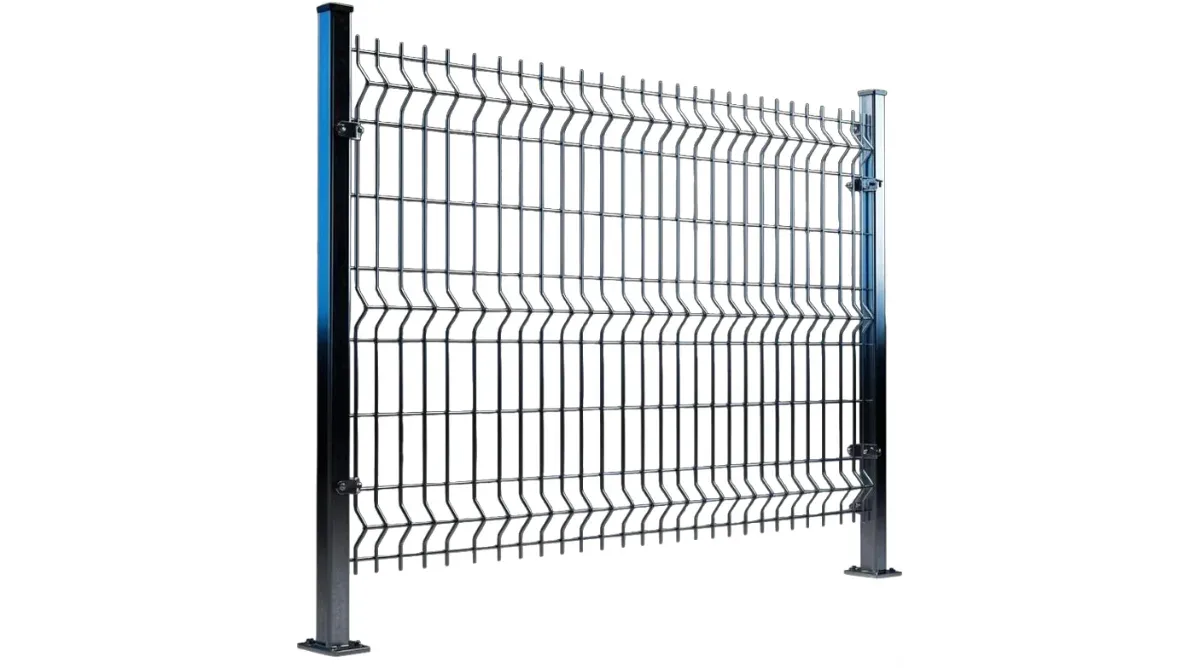
A fence system built by attaching panels made of welded wire grids to posts, which does not block the view.
Chain-link
A flexible mesh formed by weaving wires together. It comes in rolls and is installed by tensioning it between posts.
Plastic wrought-iron style fence
A low-maintenance decorative fence system that offers the decorative pattern language of wrought iron in a plastic-based material.
Artificial grass fence
A green-looking material applied on an existing wire or panel fence to create a screen. You can find the details on our artificial grass fence page.
Fence railing
Systems mounted on walls or along terrace edges that serve both as a boundary and as protection against falls. Our louvre fence railing model is used for this purpose.
CNC laser cutting
The processing of metal sheet into patterns with computer-controlled cutting machines. It is used in decorative gates and panels. You can see examples on our CNC laser-cut gate models page.
If you would like to compare fence types with each other, see our articles louvre fence or panel fence and chain-link or panel fence.
Using the Terms When Comparing Quotes
Knowing these terms helps you notice what information is missing when comparing quotes. For example, if a quote only says “galvanized panel”, you know you should ask about the type of galvanizing, the wire thickness and the panel type. For other questions to ask when choosing a company, see our article on what to look for when choosing a fence company.
Frequently Asked Questions
Which is more important, wire thickness or mesh size?
The two serve different purposes and should be assessed together. Wire thickness affects the strength of the fence, while mesh size affects what can pass through it and how difficult it is to climb. For example, in a garden with pets mesh size may matter more, while at an industrial facility wire thickness and panel type may come to the fore.
Why is wall thickness important?
In hollow profiles such as box profiles and tubes, wall thickness directly affects the strength of the profile. Of two profiles with the same outer dimensions, the one with the greater wall thickness is generally more resistant to bending and impacts. For this reason, it is important that wall thickness is stated next to the profile size in quotes.
If the RAL code is the same, are the colours exactly the same?
The RAL code defines a colour in a standard way; but gloss level, surface texture and lighting conditions can affect how the colour is perceived. In addition, small differences in tone can arise between products from different manufacturers with the same RAL code. For this reason, it is recommended that the fence and gate be obtained from the same source and the same paint system.
What is the difference between a half flange and a full flange?
Half-flange posts go at wall ends, that is, at points where the fence joins a wall; the flange plate is on one side of the post. Full-flange posts go in the middle, and the flange plate surrounds the post. Installation usually starts from the foot of the wall with a half-flange post.
What technical information should a quote include?
For a sound comparison, it is important that a quote includes the fence type, height and length, wire or profile thickness, coating type, colour, post type, section and number, fixing method, gate and automation items, scope of installation and warranty information.
This glossary of fence technical terms was prepared to help you read quotes and product pages more consciously. When you know the terms for wire thickness, mesh size, profiles, coatings and connections, you can compare different options much more soundly. For technical questions about your project, you can contact us.
Get a free site survey and price quote for your project.
Message Us on WhatsApp